

Twenty-six-year-old Tyler Foster keeps his life in duffel bags.
Books he’s asked for. Holiday gifts. Small treasures that matter to him. Instead of lining shelves or decorating his walls, he zips everything away.
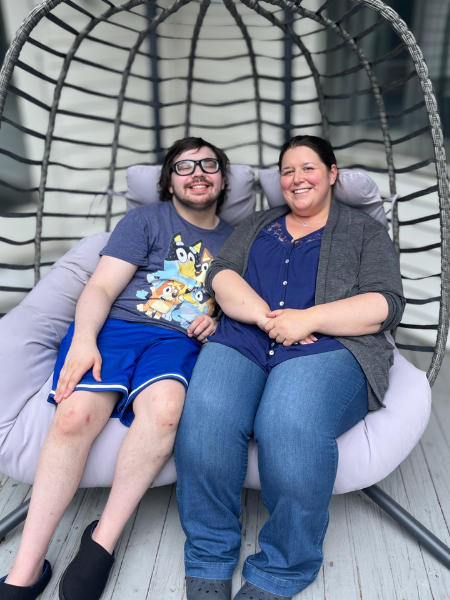
“He doesn’t feel like this place is his, and he knows the home isn’t going to be a forever thing,” said Kianna Sweeney, a Behavior Intervention Specialist at YAI’s West Milford crisis stabilization home in New Jersey. “Anything he gets, he puts it straight in his duffel bag. He doesn’t want to decorate his room.”
That is about to change.
This spring, Foster and fellow resident, Logan Moroney, will move into a newly acquired YAI-operated home just down the street. They will be supported by the same team that helped them thrive in crisis stabilization. The difference is not just the address; it’s the continuity of care. The same staff, routines, and trusted relationships remain, only this time, without a move-out date.
Crisis stabilization homes are short-term (typically about 90 days) providing intensive support to help people transition safely into longer-term settings. But for some people with intellectual and developmental disabilities (I/DD), finding the right placement is complex. Only about 15% of people with I/DD live in group home or shared residential arrangements, while many remain reliant on family or face housing instability.
At West Milford, staff saw the impact of placement shortages firsthand. As more residents remained in stabilization beds, YAI strategically developed this “rollover home,” a long-term setting for people who had progressed but lacked the right placement to move to.
Unfortunately, Foster and Moroney know what it means when a placement doesn’t work.
“Both Tyler and Logan had previously stayed in our stabilization home and were discharged to other providers,” said Amanda Duva Gannon, Regional Director of New Jersey. “Despite a thorough discharge process, including shadowing and hands-on training with receiving teams, they were unable to be safely supported in those settings and experienced significant regression within just a few months. That’s what ultimately led to their readmission.”
For Foster, structure is everything. He wants to know what’s happening, when it’s happening, and why. When routines shift unexpectedly, it can be difficult.
Since returning, staff have focused on rebuilding daily living skills and independence. Showering, once a major challenge, became a shared goal.
“Now he showers almost every day,” Sweeney said. “There are even times when he’ll independently ask to take a shower. That’s a huge success for us.”
Outings, something Foster loves, are also evolving. Many of his favorite trips revolve around food, but staff are helping him expand those experiences.
“We’re introducing more activity instead of focusing only on food,” Sweeney explained. On a recent mall trip, staff walked the entire building with him before he chose a pretzel, keeping him active and engaged.

Moroney’s growth has taken a different path. Nonspeaking, he previously relied on a picture exchange communication system (PECS), but over time that support faded. When he returned to West Milford, staff rebuilt his communication tools from the ground up.
“He likes to point to videos he likes on TV,” Sweeney said. She created customized visual boards featuring his favorite shows and foods. “He’s able to go and point to us what he wants.”
For now, the focus is on highly preferred items to reinforce success. Over time, staff hope to expand his communication so he can express discomfort, interests, and new activities he might want to explore.
These gains may seem small from the outside. But in crisis stabilization, asking for a shower, pointing to a favorite show, or walking around the mall before stopping for a snack are milestones.
Still, even as Foster has grown more independent, he has never fully unpacked.
“When someone leaves, you never know what’s going to happen.” Sweeney said. “It’s comforting knowing I’ll still work with Tyler when he moves to the new home.”
That continuity is what makes this next step different.
Foster has toured the new house multiple times, even choosing the shade of blue for his walls. His room is coming together in ways that feel unmistakably his — complete with Super Mario bedsheets on his bed, a Superman rug, and matching curtains. Moroney’s room is just as personal, as a fan of Shrek, his walls are painted green and a Shrek decal marks his door, a visible reminder that the space belongs to him.
“On paper, their referral packets don’t tell the full story, especially after unsuccessful discharges, when providers may hesitate to take a chance,” Duva Gannon said. “But Tyler is incredibly funny, and Logan is remarkably clever and intuitive. We were able to see those strengths, build trusting relationships, and create the safety and security they needed to succeed in their homes.”
For Foster and Moroney, the new house represents something rare: long-term stability built on a foundation that already works.
And for Foster, it may finally mean unzipping the duffel bag and believing that he’s finally home.