

In the shadow of federal Medicaid cuts and broader economic uncertainty, 2026 is shaping up to be a pivotal and unpredictable year for disability services across the country.
“In times of uncertainty, advocacy becomes even more critical,” said Tracy Behling, Senior Regional Support Supervisor for Hudson Valley. “The decisions being made today have real consequences for people with disabilities and their families. At YAI, we always find ways to raise our voices. Whether it’s attending rallies locally or traveling to Albany, both staff and the people we support are willing to take action.”
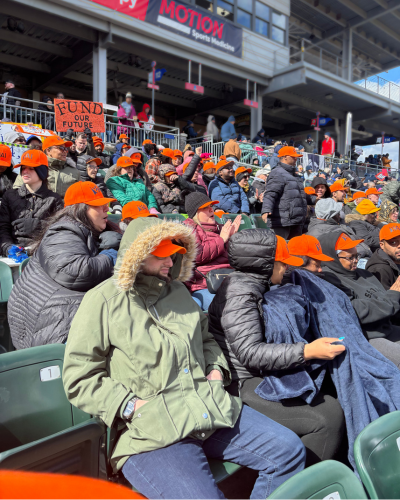
That commitment was on full display in 2025, when New York’s unprecedented “Rally in the Valley” drew thousands of advocates to a Hudson Valley stadium, including Congressmembers and state legislators for the first time. YAI mobilized hundreds of staff, family members, and people with disabilities to make their voices heard. Alongside other regional rallies, these collective efforts have expanded access to policymakers and prioritizes critical budget support.
Facing state budget shortfalls and declining federal aid, disability service providers are struggling with chronic staffing shortages and Medicaid rates that don't cover the true cost of care. Together, these pressures threaten the stability of services, but they also highlight the urgent need for reform and a departure from “business as usual.”
“While the cuts don’t directly eliminate services for people with I/DD, they significantly strain state budgets,” said Scott Karolidis, YAI’s Director of Government Relations. “When states are struggling, it becomes far more difficult to secure the funding increases providers need to sustain quality care.”
The impact of these pressures is already visible. Nearly 90% of disability service providers offering Medicaid-funded community services reported staffing shortages in 2025. More than 60% were forced to turn away new clients due to insufficient staff, and 29% discontinued services altogether.
At the heart of the workforce crisis is the inability to raise wages for Direct Support Professionals (DSPs). State budgets remain largely flat, and without substantial growth in federal funding, economic expansion, or new revenue sources, Medicaid rate increases are often limited, leaving little room to raise wages by more than a few dollars an hour.
Many states had hoped that $450 billion in Home and Community-Based Services (HCBS) funding would be secured through the Biden administration’s Build Back Better legislation. When that effort failed in 2023, no comparable alternative emerged. Matters worsened in 2025, when Congress passed deep Medicaid cuts set to take effect in 2027, reducing federal funding by as much as $15 billion for states including New York, New Jersey, and California.
So far, governors in these states have not released detailed plans outlining how they will absorb these losses. There are no clear proposals for revenue increases, alternative funding sources, or potential service reductions. While state budget agencies have warned departments to prepare for savings, and hinted across-the-board cuts, official public guidance remains limited. Without strong economic growth, many states may feel compelled to implement cuts in preparation for 2027.
“No matter the economic or regulatory environment, we’re always pushing for what our staff and the people we support need,” - Scott Karolidis
Despite these uncertainties, providers remain committed to providing high-quality care and advocating for the future. YAI is active on multiple fronts, pushing for Medicaid rate increases and policy reforms even in challenging political environments. As a member of the California Disability Services Association (CDSA), YAI is urging California to stay on track with healthcare worker wage increases and to protect funding for START programs statewide. In New York, YAI continues its advocacy through New York Disability Advocates (NYDA), fighting for rate increases, regulatory changes, and more sustainable approaches to rate setting.
“No matter the economic or regulatory environment, we’re always pushing for what our staff and the people we support need,” Karolidis said. “A tight budget or federal Medicaid cuts don’t change the fact that wages are too low and people with disabilities deserve the best.”
There are some signs which offer hope for state Medicaid budgets. If state budgets can remain stable in 2026, they may develop reserves to prepare for 2027. In New York, Governor Hochul has signaled a historic openness to raising tax rates to increase revenue. Furthermore, early polling for the 2026 midterms suggests a potential shift in Congress that could lead to restored Medicaid funding and renewed federal support for states.
Disability service providers have faced disinvestment before and emerged stronger. Even under pressure, the combined power of provider commitment and relentless advocacy ensures that progress never stops.
“Even in tough budget environments, progress is possible when providers, DSPs, and advocates stay focused on what people with disabilities need,” Karolidis added. “That persistence will help carry services through 2026 and position states to make better decisions in the years ahead.”
Sign up today to learn more about YAI's advocacy efforts.