

When Elizabeth's daughter, Princess, was born six weeks early and placed on a feeding tube, hospital staff didn't just see a fragile newborn; they saw a mother with an intellectual and developmental disability (I/DD) and assumed the worst. It was an assumption Elizabeth has spent her whole life fighting.
Elizabeth, 40, was bounced through roughly 50 foster homes before she found stability. When she became a mother herself, she made a promise: her daughter would never be caught in the same system.
That promise was tested almost immediately. Princess wasn't gaining weight, and the feeding tube meant to help her get the calories she needed became, in the eyes of hospital staff, evidence that Elizabeth wasn't managing her care correctly.
"From beginning to end, it was hard, but Princess was staying with me," said Elizabeth. "I was going to learn everything and take care of her no matter what."
"Everybody was like, 'Oh, she can't do it because she's got a disability,'" said Kathryn Wright, Supervisor of YAI's Essential Parent Skills Training Program, which runs together with the Administration for Children's Services (ACS) Developmental Disabilities Unit. "What we realized is nobody had actually broken down for her how to do it. It wasn't anything she was doing wrong."
That assumption isn't rare. A 2012 report from the National Council on Disability found that parents with intellectual disabilities lose custody of their children at rates ranging from 40 to 80 percent. As of 2025, 37 states and four U.S. territories still allow a parent's disability alone to serve as grounds for terminating parental rights.
Elizabeth felt those assumptions everywhere. She remembers a stranger at a bus stop looking at Princess's feeding tube and assuming, wrongly, that the baby had been exposed to drugs. "I felt so ashamed," Elizabeth said. "Sometimes I was hiding myself with her in my house, not coming out, because that was embarrassing."
For Elizabeth, the turning point came through the Parent Skills Training program, which provided coaching built around what she actually needed, not a one-size-fits-all script. Wright and her team worked with Elizabeth's hospital care team to make sure instructions were clear and that she had the right resources.
"Elizabeth is very vocal; she can stand up for herself," Wright said. "But she felt like nobody was listening to her. We tried to create a space where she could explain what was going on and be seen as a parent."
The core parenting program is funded through ACS, and covers the basics: staff, classes, skills-building. But it doesn't leave room for much else. That's where a separate, supplemental source of funding comes in: New York City Council's discretionary Children Under Five initiative, which YAI has received since 2024. This year, the initiative allocated $1.5 million across 11 nonprofits citywide. Where the ACS-funded training builds skills, the Children Under Five funding offers individualized supports.
“Too often, funding for families is measured only by services delivered, hours of training, or boxes checked. But raising a child is about more than skills, it is about connection," said Chairperson of the New York City Council Committee on Disabilities, Shahana Hanif. "This funding exists because every parent and child deserves the chance to simply enjoy one another. For parents with intellectual and developmental disabilities, that opportunity should not be conditional; it should be a given.”
That gap is exactly what the funding fills. A parent who uses a wheelchair was given a baby harness and a rocker so she could hold her child safely during supervised visits. Families in shelters received basics for bath time and reading; other parents received sensory toothbrushes, toys for neurodivergent children, and tablets to keep kids occupied during long waits at places like the DMV.
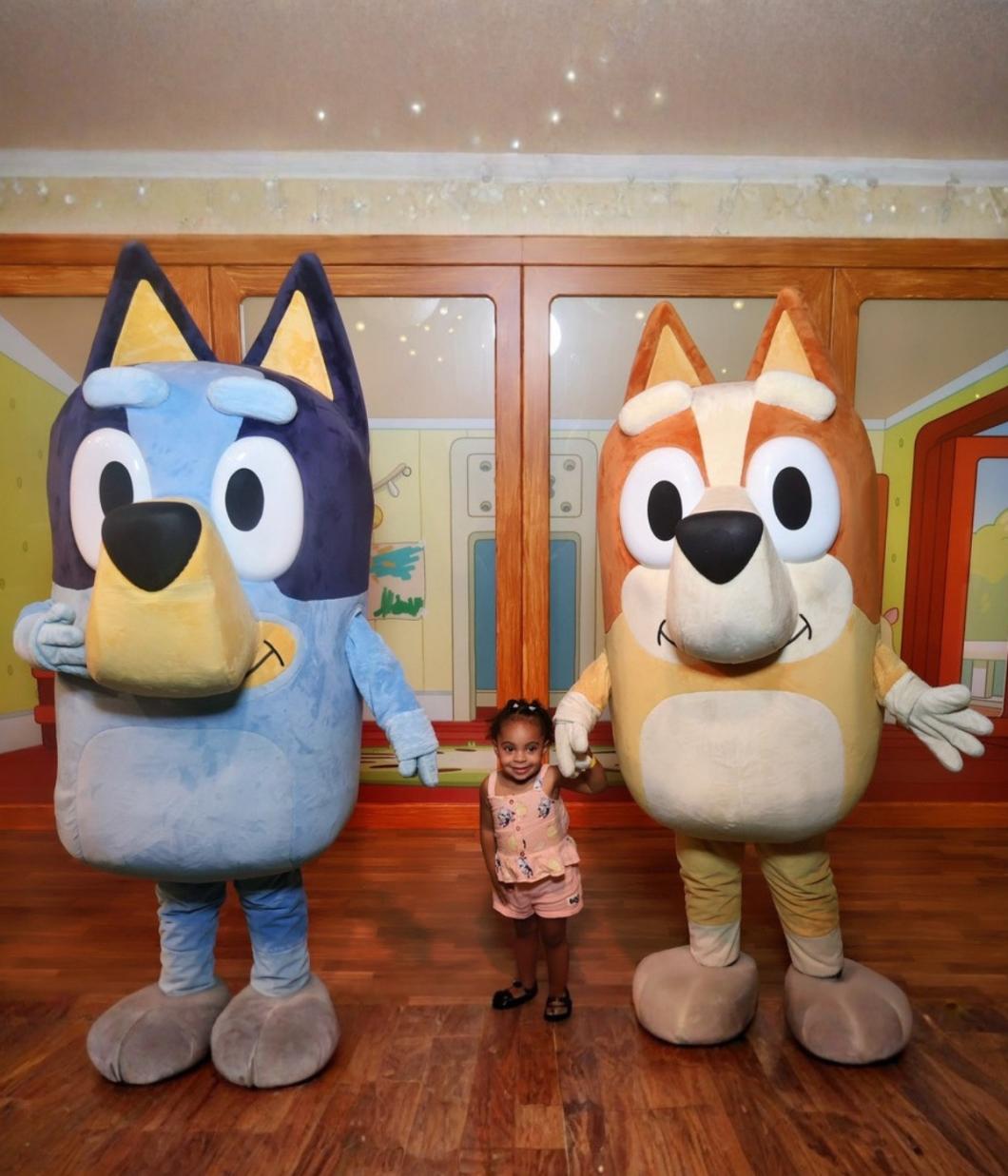
For Elizabeth, the funding helped pay for educational toys she could use with Princess at home, since she isn't yet comfortable with daycare. This summer, it made something else possible: fun, with no clinical purpose attached. Princess is an enormous fan of the children's show Bluey, and through the fund, Elizabeth was able to take her to see Bluey twice at the CAMP store in Manhattan.
"It's something I never had as a child myself," Elizabeth said. "I had a great time too, I felt like I was part of the Bluey team. Seeing her hug Bluey, smile like that, it got me so emotional."
For Wright, moments like that are the whole point. "A lot of the parents in my program were never taught how to play," she said. "This funding has been life changing and has sparked so much joy." The need for these services continues to grow, with families across New York City seeking support on a consistent basis.
Nearly three years after that frightening start, Princess is, in her mother's words, "a loving, educated baby" who talks constantly and is closing in fast on every milestone.
"Kids don't come with a manual," Elizabeth said. "It's hard work. But I thank Kathryn for all the adventures and for helping make my little girl's dreams come true."